MCGS-SLAM

A Multi-Camera SLAM Framework Using Gaussian Splatting for High-Fidelity Mapping


1 ETH Zurich     2 University of Zurich     3 University of Stuttgart     4 Microsoft     5 University of Amsterdam

*Project Lead

IEEE International Conference on Robotics and Automation (ICRA), 2026


Why Multi-Camera SLAM?

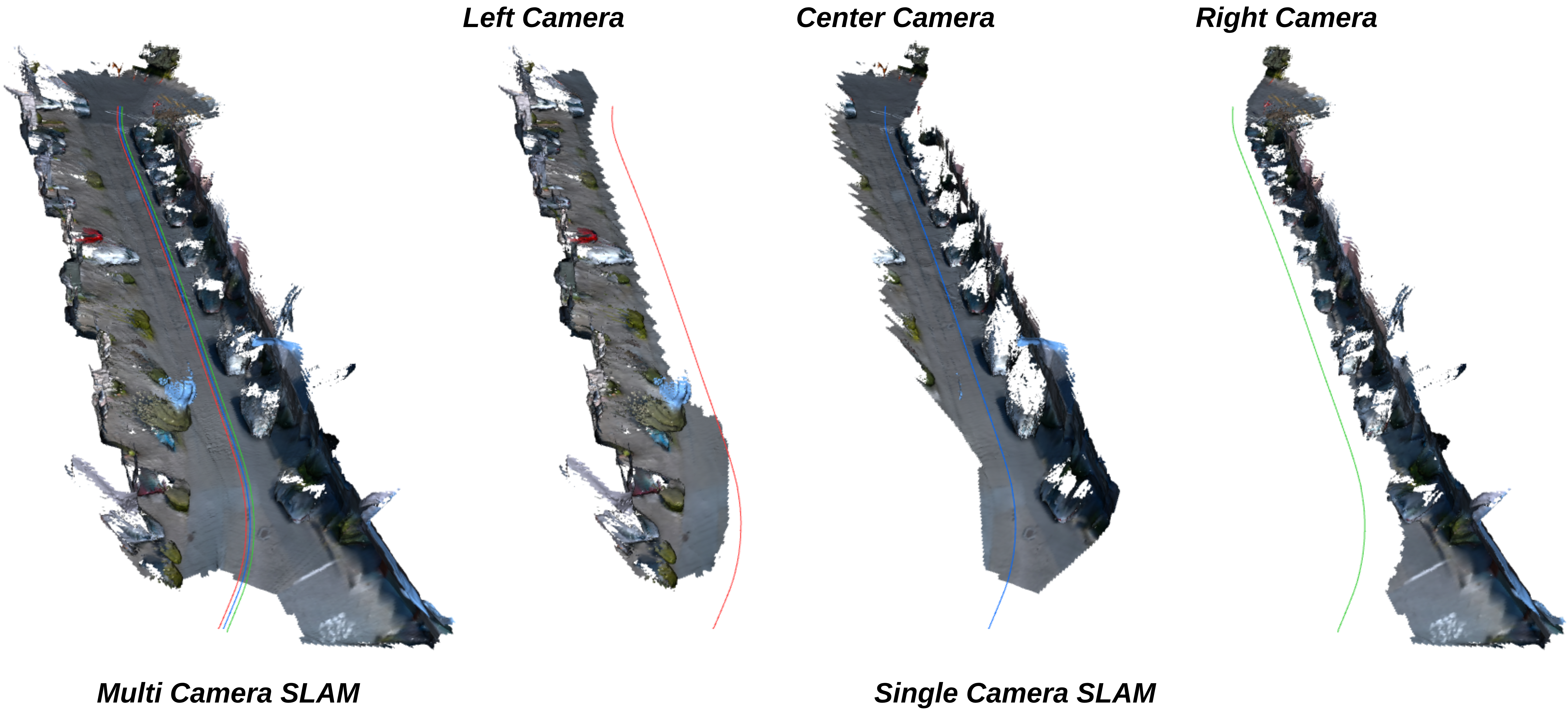
A single camera only reconstructs the part of the scene within its field of view. Each individual camera (left, center, right) covers a partial region, while multi-camera fusion produces a complete and globally consistent reconstruction.

Right Image

Click a thumbnail to swap meshes and compare per-camera coverage against the fusion under the same viewpoint.


SLAM System Pipeline

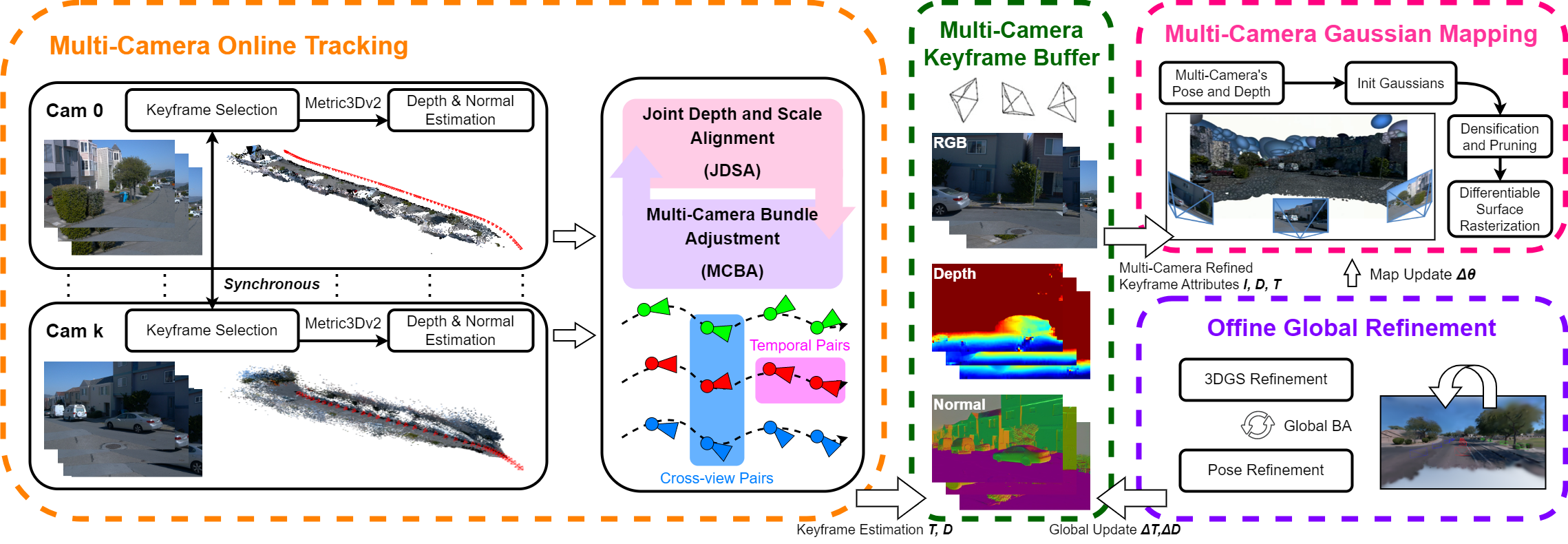
Our method performs real-time SLAM by fusing synchronized inputs from a multi-camera rig into a unified 3D Gaussian map. It first selects keyframes and estimates depth and normal maps for each camera, then jointly optimizes poses and depths via multi-camera bundle adjustment and scale-consistent depth alignment. Refined keyframes are fused into a dense Gaussian map using differentiable rasterization, interleaved with densification and pruning. An optional offline stage further refines camera trajectories and map quality. The system supports RGB inputs, enabling accurate tracking and photorealistic reconstruction.

Right Image

Analysis of Single-Camera and Multi-Camera System

This experiment on the Waymo Open Dataset (Real World) demonstrates the effectiveness of our Multi-Camera Gaussian Splatting SLAM system. We evaluate the 3D mapping performance using three individual cameras, Front, Front-Left, and Front-Right, and compare these single-camera reconstructions against the Multi-Camera SLAM results.

The comparison highlights that the Multi-Camera SLAM leverages complementary viewpoints, providing more complete and geometrically consistent 3D reconstructions. In contrast, single-camera setups are prone to occlusions and limited fields of view, resulting in incomplete or distorted geometry. Our approach effectively fuses information from all three perspectives, achieving superior scene coverage and depth accuracy.
Right Image

Analysis of Single-Camera and Multi-Camera SLAM (Mapping)

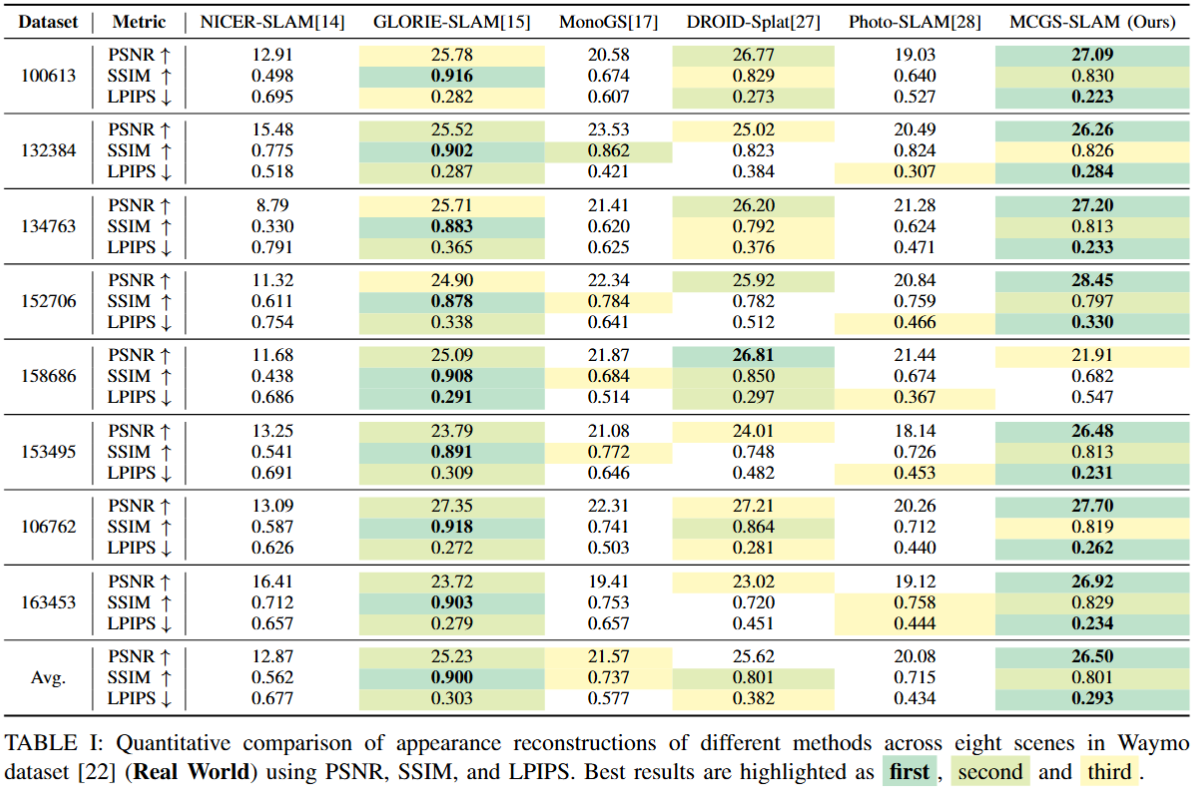
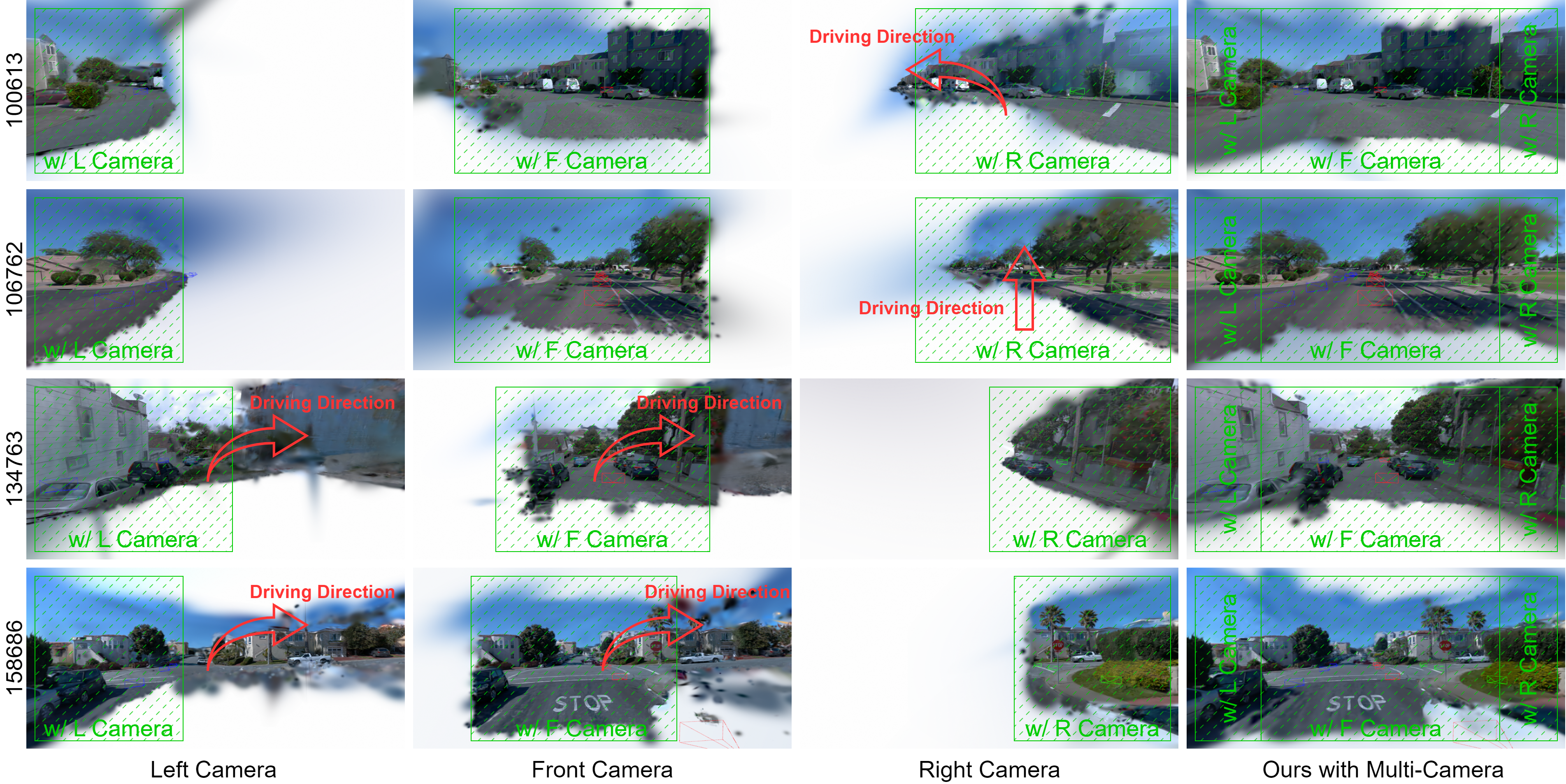
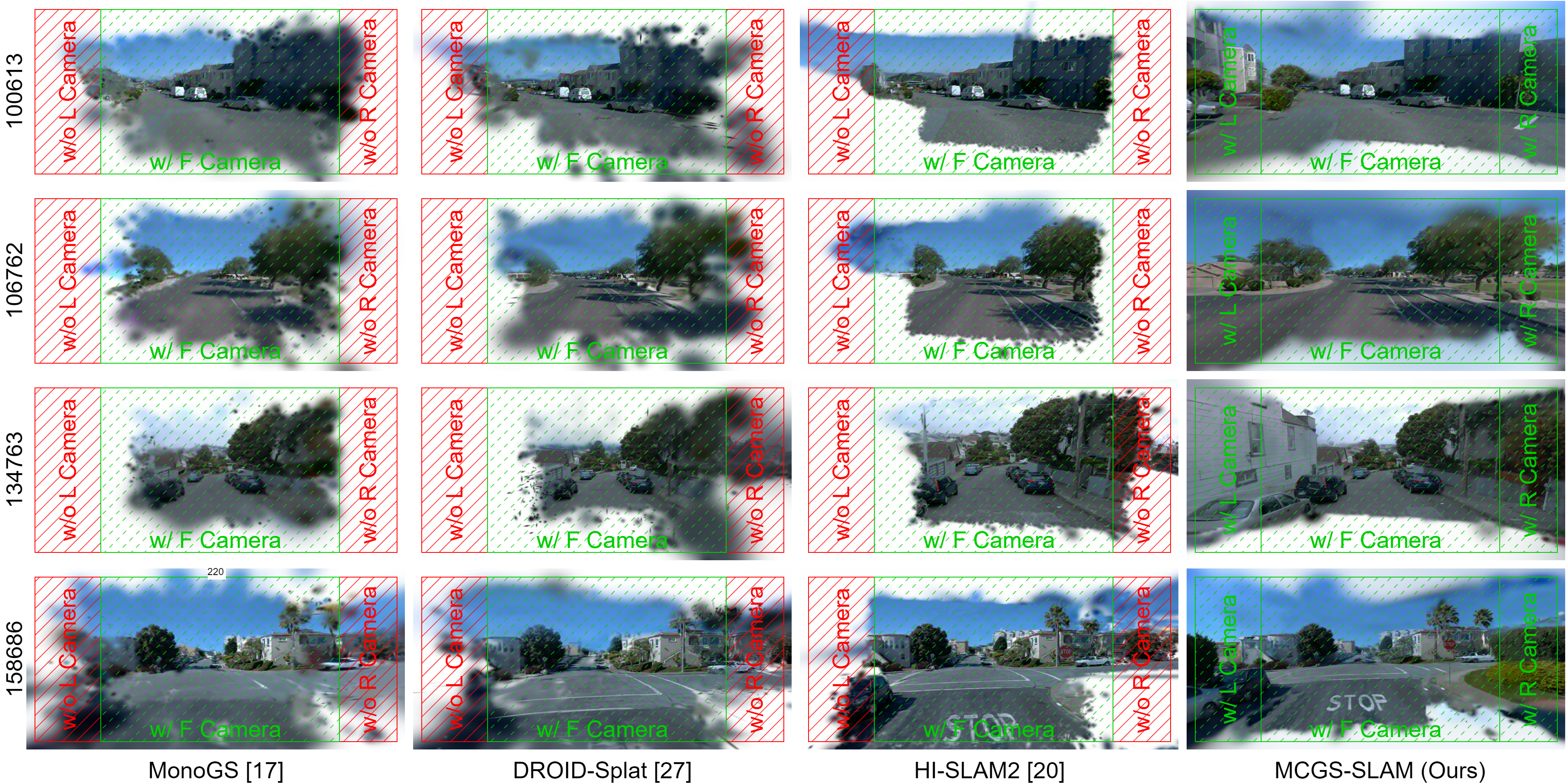
Here, we conduct a comparative analysis between single-camera SLAM and our Multi-Camera Gaussian Splatting SLAM system within the Waymo Open Dataset (Real World), further benchmarking against state-of-the-art methods. The visual comparisons clearly demonstrate that our multi-camera approach significantly outperforms single-camera methods, providing more complete and consistent 3D scene reconstructions. Our system also achieves more scene details and ensures a richer 3D representation than others, highlighting the benefits of leveraging multiple viewpoints through Gaussian Splatting and Multi-Camera system.
Right Image

Right Image

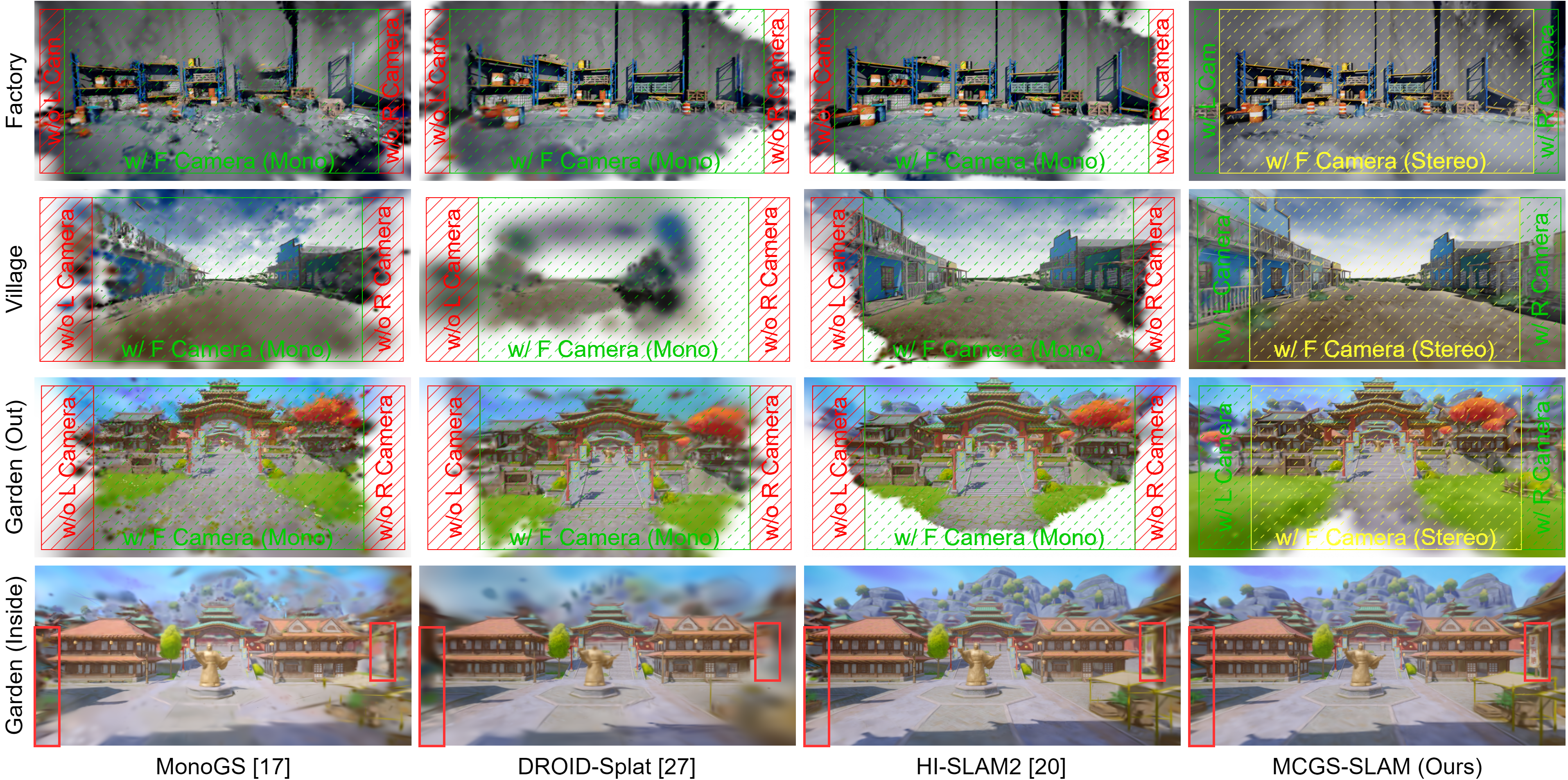
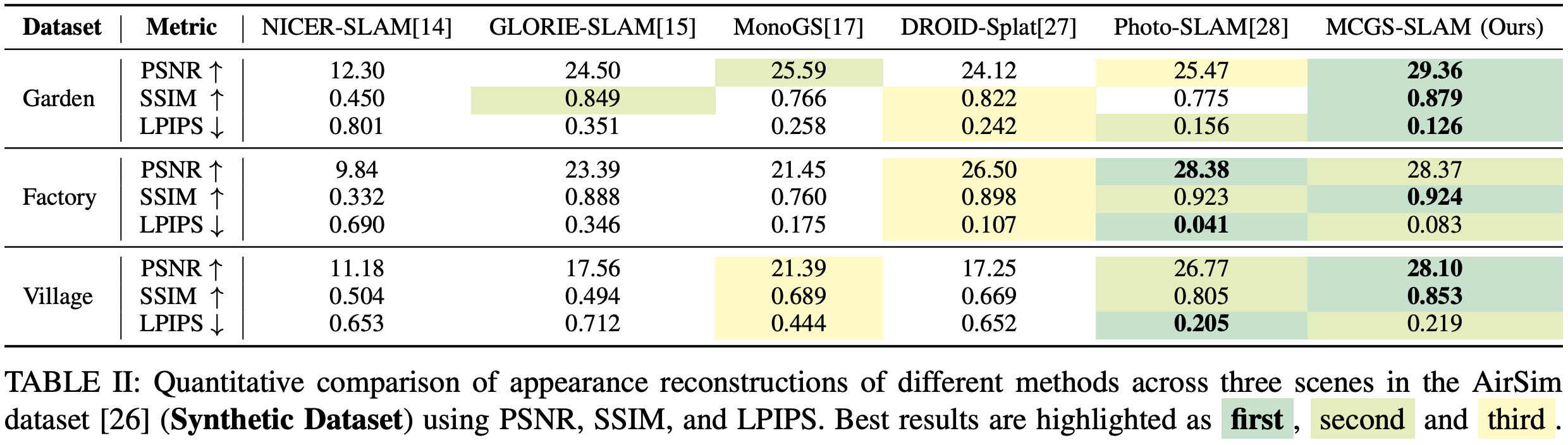
Also, we present a comparative analysis between single-camera SLAM and our Multi-Camera Gaussian Splatting SLAM system within the AirSim environment (Simulation). The visual comparisons in the figure and the quantitative results in the table clearly underscore the advantages of our multi-camera approach, which consistently produces more complete and coherent 3D reconstructions than single-camera methods.
Right Image

Right Image

Analysis of Single-Camera and Multi-Camera SLAM (Tracking)

In this section, we benchmark tracking accuracy across eight driving sequences from the Waymo dataset (Real World). MCGS-SLAM achieves the lowest average ATE, significantly outperforming single-camera methods.
Right Image

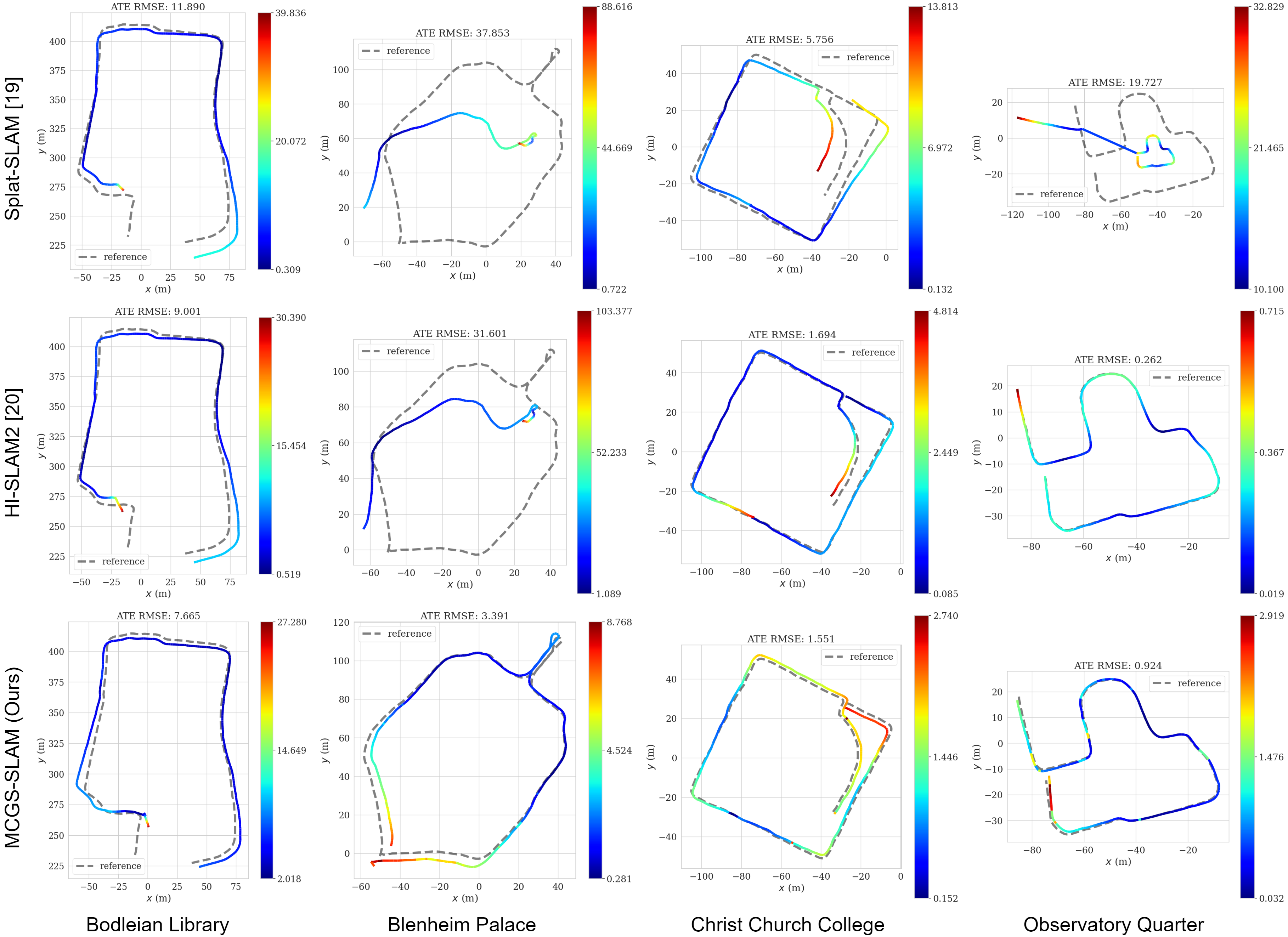
We further evaluate tracking on four sequences from the Oxford Spires dataset (Real World). MCGS-SLAM consistently yields the best performance, demonstrating robust trajectory estimation in large-scale outdoor environments.
Right Image

Right Image

Citation

If you find this work useful, please consider citing:

@article{cao2025mcgs,
  title={Mcgs-slam: A multi-camera slam framework using gaussian splatting for high-fidelity mapping},
  author={Cao, Zhihao and Wu, Hanyu and Tang, Li Wa and Luo, Zizhou and Zhang, Wei and Pollefeys, Marc and Zhu, Zihan and Oswald, Martin R},
  journal={arXiv preprint arXiv:2509.14191},
  year={2025}
}